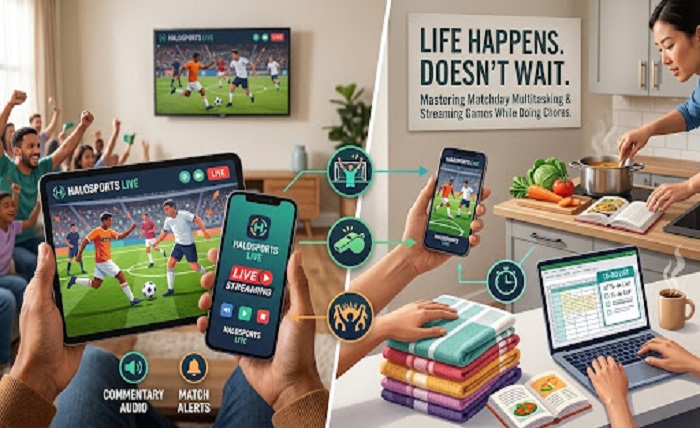
I used to think a proper match demanded two uninterrupted hours and my eyes fixed on every pass. Real life kept proving otherwise. Laundry piled up, dinner still needed cooking, and small jobs followed me into the weekend. Rather than miss football on crowded days, I learned to let the game share my attention without pretending I could follow every second.
That change did not make me less interested. It made me more deliberate. I now decide in advance which parts of my day can sit beside a live stream and which cannot. Some matches become the main event; others accompany routine work until the tempo changes. The difference is not how many minutes I watch, but whether I am choosing where my attention goes.
Three Modes for a Busy Matchday
My first mode is background listening. I use it during predictable stretches of a match or when my hands are busy but my mind is free. Commentary carries the shape of play while I handle routine chores. I glance over when the crowd rises or the commentator’s pace changes, then return to the task once the moment settles.
The second is frequent-glance viewing, useful for admin, meal preparation, or light tidying. Full focus is for the opening minutes, dangerous attacks, set pieces, and tense finishes. Switching between these modes matters more than trying to split my attention evenly. With halosports live streaming open, I still make those choices myself rather than assuming every minute belongs in the background.
Tasks That Pair Well—and Those That Do Not
The safest companion tasks are familiar, interruptible, and low risk. Folding laundry, watering plants, organizing a drawer, prepping cold ingredients, or doing a simple workout let me stop instantly. They require little thought, and a sudden chance on goal will not ruin the job. Repetitive household chores often feel shorter when the commentary gives them a rhythm.
I avoid pairing a match with driving, handling sharp tools during demanding food preparation, managing money, signing documents, or writing something that requires careful judgment. Deep reading and important conversations also deserve full attention. My test is simple: if missing one step could cause harm, cost money, create an error, or disrespect another person, the stream waits. Entertainment should fit around responsibility, not weaken it.
Letting Audio Carry the Match
Good commentary acts like an early-warning system. I listen for a quicker delivery, a rising crowd, a referee’s whistle, or the sudden pause before a replay is discussed. Those cues tell me when the ordinary flow has broken. They are especially useful when I cannot keep the screen in view, because they let me follow momentum without constantly turning my head.
I keep the volume clear enough to understand speech but low enough that it does not take over the room. If I am using headphones, I usually leave one ear free at home so I can hear timers, doors, or other people. Audio is a guide, not proof that I caught everything. When the sound suggests a key moment, I stop safely before looking.
Knowing When to Put Everything Down
Certain moments always earn my full attention: the opening few minutes, a penalty decision, a free kick near goal, an injury, a substitution that changes the shape of the game, and the closing stages of a tight scoreline. Rivalry matches and knockout games also tend to move into full-focus mode much earlier. I would rather pause a chore than half-see the moment I will discuss later.
I also watch for patterns instead of waiting only for obvious drama. Repeated pressure, tired defenders, or a team pushing numbers forward can signal that something is building. That is when I dry my hands, set the laundry aside, or stop typing. Choosing to watch before the decisive moment feels far better than scrambling toward the screen after hearing a roar.
Placing the Screen Without Creating a Hazard
Device placement decides whether multitasking feels smooth or irritating. I put the screen at a natural glance angle, away from water, heat, steam, food splashes, and busy walkways. A stable stand is better than leaning a phone against a mug. In the kitchen, I keep it well beyond the preparation area; during chores, I choose one fixed surface rather than carrying it from room to room.
I also resist making the picture larger than the space requires. A laptop can work at a desk or table, while a phone suits a nearby shelf for audio-led following. The aim is quick, safe access, not a screen that dominates every movement. If I need to twist, bend, or cross the room to check play, the setup is working against me.
Keeping Notifications From Spoiling the Flow
Nothing breaks a match faster than a goal alert arriving before the stream shows it. Before kickoff, I silence sports notifications, hide score widgets, and mute group chats that tend to post instant reactions. I leave essential calls available, but most banners can wait. This also keeps unrelated messages from pulling me into an entirely different task each time I glance at the screen.
When I stream matches online, I treat the viewing device as a match screen rather than a second inbox. I close unnecessary tabs and avoid checking social feeds during play. If a message genuinely needs action, I pause what I am doing and answer it properly. Trying to watch, work, and reply at once usually means doing all three badly.
Drawing a Firm Line Around Work
Working from home can make a daytime fixture tempting, but I do not treat every work task as suitable background activity. Routine filing, inbox cleanup, or formatting may coexist with commentary when my schedule allows it. Meetings, deadlines, analysis, client communication, and creative work do not. If someone is paying for my attention, the match cannot quietly claim part of it.
I set boundaries before kickoff instead of negotiating with myself minute by minute. That might mean finishing a focused block first, watching only during lunch, or leaving the stream off until a scheduled break. On a genuinely busy day, I accept that highlights may be the better choice. Protecting work quality removes the guilt that makes both the job and the match less enjoyable.
Deliberate Multitasking Is Not Distracted Viewing
Distracted viewing happens when every alert, tab, chore, and conversation competes at once. I reach the final whistle unable to describe the match, yet nothing else feels finished either. Deliberate multitasking is narrower. I pair the game with one suitable activity, decide what deserves priority, and create clear triggers for switching my attention. The arrangement has rules, even if it looks casual from across the room.
That is why matchday multitasking works for me. I am not trying to squeeze maximum output from every minute or claim I never miss a pass. I am making a practical trade: routine tasks move forward, football stays present, and important moments still receive my full attention. When the final whistle goes, I want a finished chore and a match I actually remember—not two hours lost between them.