Introduction
Where uninterrupted operation takes precedence, such as in lottery terminal operations and data security, equipment failure simply cannot be an option. Downtime means lost money and lost customers’ faith. The primary reason behind equipment failure in many cases lies with the smallest building blocks, the inner metallic constructions such as chassis frame, guide rails, and brackets. Deformation or tolerance stack-up in those elements, when left unchecked, may bring about catastrophic system failure down the road.
This problem starts with how metal fabrication is done conventionally, favoring affordability and aesthetics above functionality and longevity in some cases. Bending techniques that are typically employed might fail to offer sufficient accuracy, repeatability, and stress resistance necessary to create quality parts meant for high-load environments.
This article will showcase just why precision metal bending services and custom metal forming are essential considerations when it comes to achieving zero system failure in your vital equipment. It will shed light on the benefits provided by the service that contributes to this end goal.
Why Does the Reliability of Lottery Terminals and Security Devices Begin with a Perfect Bend Angle?
Consider the internal metal framework, card slots, and hinges of a lottery terminal or a data server cabinet. These components define the device’s core structure and movement.
This initially results in improper fitting when assembling the components because they have to be forced together, causing points of stress in the component. The stress eventually leads to wear of the mating components such as sliders and joints.
This accelerated wear leads to increased friction, causing mechanisms to stick or jam. Electrical contacts may become intermittent. Ultimately, the cumulative effect can be a complete structural or functional failure of the device. Therefore, the core value of a high tolerance metal bending service is to ensure every bend’s geometric precision—angle, radius, and straightness—conforms perfectly to design, establishing the physical foundation for seamless assembly and long-term stability. Learn more about the technical foundations in this detailed blog on precision metal bending service.
Beyond Close Enough: How Custom Metal Bending Service Meets Complex Equipment Structural Needs?
The movement towards miniaturization and functionality calls for greater intricacies in the design of metal products that feature more than one bend, incorporate holes, or have embossed designs.
While standard bending follows a set pattern, custom metal bending service requires DFM analysis. The engineers reverse-engineer the process based on the function of the part, its space limitations, and its structural needs to develop the order of bends, choose the appropriate tooling, and compensate for springback.
In such a way, intricate and one-piece bent parts become possible. A custom metal bracket will be a replacement for an assembly of several pieces welded together. Custom metal forming service results in decreased number of parts, reduced assembly process, fewer areas prone to failures, and improved structural rigidity and accuracy of the final product.
From Millimeters to Microns: What Do Process Control and Certification Systems for Tight Tolerance Metal Bending Mean?
For precision equipment, the gap between ±0.5mm and ±0.1mm is not an additive one but rather the line separating efficiency from excellence.
Key Technical Drivers
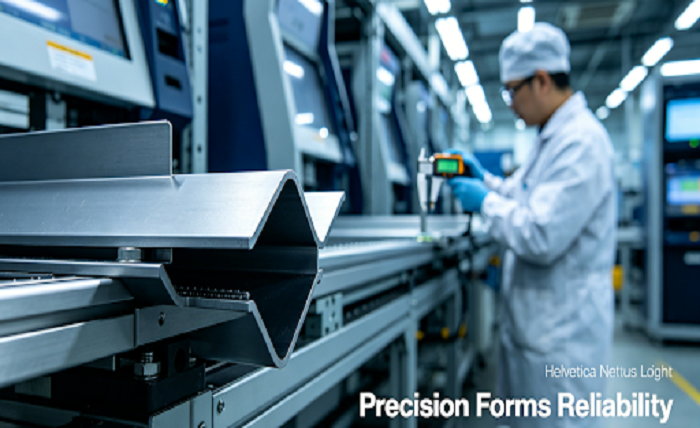
The ability to perform consistently tight tolerance metal bending lies in the effective combination of modern hardware and process know-how. This is achieved through the use of CNC press brakes with very high repeatability, measurement lasers for constant monitoring, and an extensive database of tooling designed to handle specific types of metals in specific gauges.
Holistic Process Control via Quality Management Programs
This control process is further formalized in certifications such as ISO 9001, IATF 16949, and AS9100D. To be a successful provider of metal bending services, however, means more than simply receiving such designations—it implies a commitment to their standards. This guarantees that all processes, from metal analysis to the final inspection of each piece, will always be controlled and consistent.
- Certifications as a Control Guarantee
Achieving reliability in high-precision metal forming processes requires a system-wide perspective. ISO 9001, IATF 16949, and AS9100D certifications offer the structure to achieve precise control, traceability, and continuous improvement in the processes involved.
- From Standard to Operational Reality
For a provider, these are operational mandates. They ensure every step—from order processing to final audit—is controlled and monitored, guaranteeing batch-to-batch consistency and transforming a metal bending service into a trusted extension of a client’s quality system.
How Does Precision Metal Forming Service Reduce the Total Cost of Ownership for Equipment Manufacturers?
The misconception that higher precision equates to higher cost is overturned by a Total Cost of Ownership (TCO) analysis. A precision metal forming service delivers value across the entire product lifecycle.
Reducing Costs in Production and Assembly
Since the parts are precision made, they fit perfectly right from the beginning without spending any expensive hours on adjusting and fitting them. In addition to that, scrap rates become almost negligible, which means that there will be no hassle involved in handling any return orders from the customers.
Adding Value Post-Delivery
It’s post-delivery when the biggest cost savings can be seen. Equipments using the precision made, highly reliable parts have very few failure instances in the field, thus assuring high uptime of the equipment in the field. High reliability results in lower maintenance costs, lower spare parts inventory, and zero down time. The resulting competitive edge is definitely an added value.
- Maximizing Operational Uptime
However, the biggest cost savings come when the equipment is delivered to its final destination. Machinery that has been manufactured using very dependable, accurately shaped components will have much fewer cases of failure in the field, thereby guaranteeing higher productivity for the consumer.
- Gaining Market Dominance
The reliability of the machinery in the field can be used as a huge competitive edge by the equipment supplier when bidding.
What Key Capabilities Beyond the Quotation Should You Evaluate in a Metal Bending Partner?
When selecting a partner for precision metal bending service, decision-makers should look beyond the unit price on a quote. A due diligence checklist should include:
When evaluating a precision metal bending service partner, looking beyond the unit price is crucial. A thorough assessment should verify proactive engineering support for DFM analysis and a deep-rooted quality culture evidenced by rigorous inspection protocols (FAI, IPQC, FQC) and advanced metrology like CMMs. Furthermore, essential material science expertise for predicting springback and behavior of various alloys, combined with objective proof of a systemic approach—such as IATF 16949 or AS9100D certification and full order traceability—forms the true foundation. These soft capabilities collectively guarantee the consistent delivery of high precision metal bending and long-term reliability.
Conclusion
In summary, in the pursuit of ultimate reliability in equipment manufacturing, the precision of metal structural components has evolved from a manufacturing detail to a strategic core. Investing in professional, system-driven precision metal bending and forming services is not a simple cost but a critical investment in long-term product competitiveness and market trust. It mitigates device failure risk at the manufacturing source, delivering invaluable operational assurance to the end-user.
For those developing next-generation critical equipment, it is essential to thoroughly evaluate the complete capability spectrum a professional precision metal bending service provider should possess. Assessing their technical depth, quality systems, and proven case studies is key to making an informed partnership choice for your vital project.
Author Biography
This article was contributed by a technical consultant with over a decade of experience in the precision manufacturing sector, specializing in the application of advanced fabrication processes to enhance the reliability of high-end equipment. The insights are based on long-term observation and analysis of leading global manufacturing supply chains.
FAQs
Q: What are the common tolerance levels in high precision metal forming?
A: Tolerances are normally in the range of ±0.1mm to ±0.5mm, based on the type of metal used and the bending process. These strict tolerances can be reliably achieved by professional metal formers using proper equipment.
Q: How does custom metal forming differ from regular bending?
A: Early involvement of engineering is the key differentiating factor. Custom metal forming involves DFMA analysis in order to design a process which optimizes the part design and functionality, overcoming any difficulties related to spring-back and producing intricate monolithic parts.
Q: What kind of industry uses high-precision metal forming services the most?
A: Industries where reliability of components is very important constitute major sources of demand. These include aerospace, medical devices, premium electronic products, automation/robotics and instrumentation systems. Any deviation from required dimensions could cause entire system to fail.
Q: What is the implication of having IATF 16949 and AS9100D certification as a metal bending service provider?
A: Both of these are top-of-the-line quality management system certificates in the automotive and aerospace industry, respectively. Having such means that the provider possesses an incredibly strict quality process control system, traceability, and continuous improvement capabilities. The provider’s capability in managing quality goes beyond average, thereby meeting stringent industry standards in terms of reliability.
Q: How can one determine whether a metal bending service provider possesses high quality?
A: It is possible by asking to see the quality management certificates of the service provider, asking for inspection certificates of some standard parts (such as FAIR), and asking whether they have a CMM machine. Another way is through gauging the level of expertise of the engineering staff in terms of material science and processes and design optimization.