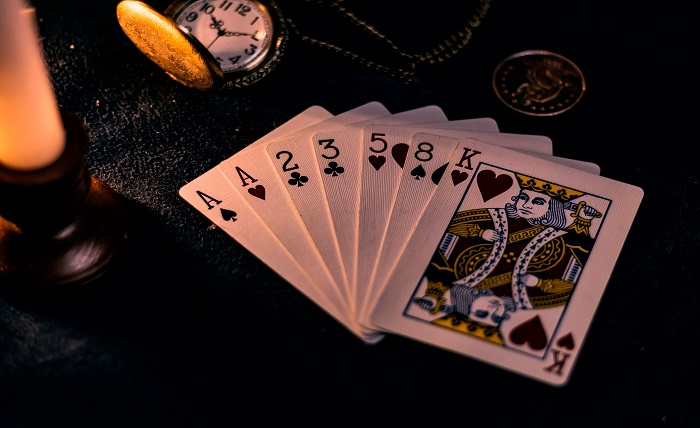
Indian Rummy is easy to recognise but surprisingly easy to play incorrectly.
Every player begins with 13 cards. The aim is to arrange those cards into valid sequences and sets, drawing one card and discarding one on each turn until the hand is complete.
The important part is that not every collection of valid-looking groups makes a valid hand.
Indian Rummy has one requirement that shapes almost everything else: at least one sequence must be pure.
Understand that rule first, and the rest of the game becomes much easier to follow.
What happens to the 13 cards?
A standard game deals 13 cards to each player.
During a turn, a player draws one card from the available pile and then discards one, returning the hand to 13 cards.
Those cards are gradually organised into two types of combinations:
Sequences — consecutive cards belonging to the same suit.
Sets — cards of the same rank belonging to different suits.
For example:
5♠ 6♠ 7♠ is a sequence.
9♠ 9♥ 9♦ is a set.
A completed hand can contain both, but sequences carry an additional requirement that sets do not.
Why the pure sequence matters
A pure sequence contains consecutive cards of the same suit without using a joker as a substitute.
For example:
4♥ 5♥ 6♥
is a pure sequence.
Now consider:
4♥ 5♥ Joker 7♥
The joker can represent the missing 6♥, making the group useful, but the resulting run is impure.
That distinction matters because a valid 13-card hand requires at least two sequences, and at least one must be pure.
Someone learning the complete structure can use TaashKhel’s guide to 13 card Indian Rummy as a reference for the deal, sequences, sets, jokers and declaration rules.
The second sequence can be different
Once a pure sequence has been secured, the second required sequence has more flexibility.
It may also be pure:
8♣ 9♣ 10♣
or it may use a joker to fill a missing position.
This is one reason jokers become more useful after the natural sequence has been established. They can help complete the remaining groups without affecting the compulsory pure sequence.
A hand can contain more than two sequences as well. Two is the minimum requirement, not the maximum.
Sets follow a different pattern
Sequences are based on consecutive ranks in one suit.
Sets do the opposite: the rank stays the same while the suits change.
For example:
Q♠ Q♥ Q♦
forms a three-card set.
A four-card set can use all four suits:
7♠ 7♥ 7♦ 7♣
Indian Rummy commonly uses two decks, which creates an important detail. Two identical cards of the same suit should not simply be treated as two different suits within the same set.
A valid set is built from matching ranks across different suits.
Sets are useful, but they are not compulsory
This is one of the rules new players often misunderstand.
A finished hand does not necessarily need a set.
It does need the required sequences.
A player could theoretically arrange all 13 cards into valid sequences and still satisfy the basic grouping requirement.
The reverse does not work. Several excellent sets cannot compensate for a hand that is missing the required sequences or its pure sequence.
That is why experienced players tend to look for natural runs early rather than building every available pair into a potential set.
What do jokers actually do?
Indian Rummy uses jokers to substitute for missing cards in eligible combinations.
A joker might turn:
10♦ J♦ + Joker
into an impure sequence.
It might also complete:
K♠ K♥ + Joker
as a set.
That flexibility makes jokers valuable, but they do not remove the pure-sequence requirement.
If every promising sequence depends on a substitute, the hand can still be incomplete even when most of the cards appear neatly grouped.
Drawing and discarding change the hand one card at a time
The opening deal is only a starting point.
On each turn, one new card enters the hand and another leaves it.
Suppose you hold:
6♣ 7♣
Drawing the 5♣ or 8♣ immediately creates a natural sequence opportunity.
Or suppose you hold:
J♠ J♦
A jack from another suit can help build a set.
This is the basic rhythm of Indian Rummy: identify what the hand needs, draw, reconsider the possible groups and discard a card that contributes least to the structure.
A valid-looking hand can still fail
Imagine these groups:
3♠ 4♠ 5♠
8♥ 9♥ Joker
K♣ K♦ K♥
6♦ 7♦ 8♦ 9♦
The first group is a pure sequence.
The second is an impure sequence.
The third is a set.
The fourth is another natural sequence.
All 13 cards are organised, the hand contains the required sequences, and at least one is pure.
Now imagine that every sequence in the same hand depends on a joker.
The cards might still look organised, but the pure-sequence requirement has disappeared. That small difference changes whether the declaration is valid.
Check the structure before declaring
Before completing a hand, four questions are useful:
Are all 13 cards properly grouped?
Are there at least two sequences?
Is at least one of those sequences pure?
Are any sets formed correctly using different suits?
This final check is important because an incorrect declaration can come from something as small as an overlooked joker or an invalid set.
Why Indian Rummy is more than matching cards
At first glance, Rummy can look like a game of finding cards that belong together.
The real structure is more specific.
A player is constantly deciding which potential combinations deserve to be protected, which incomplete groups are worth waiting for, and where a joker provides the most flexibility.
The pure sequence acts as the foundation.
Once that exists, the second sequence, sets and remaining cards become much easier to organise.
That is the simplest way to understand a 13-card Indian Rummy hand: secure the required sequences first, then solve everything that remains.