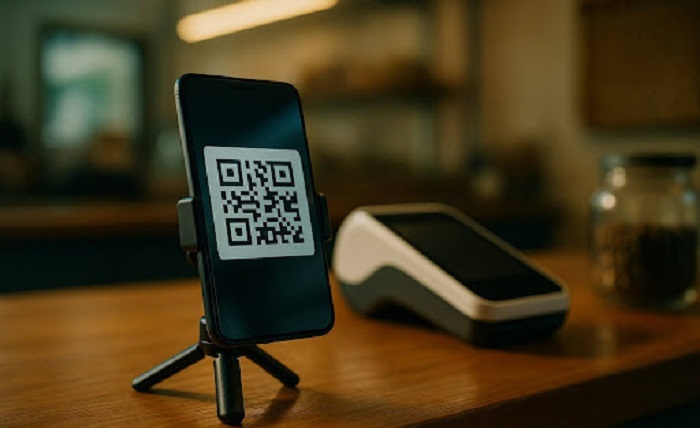
Five years after Bank Indonesia mandated QRIS as the country’s unified QR-payment standard, the technology has moved from a payment option to the substrate that most consumer-facing online services now assume. By the central bank’s own count, QRIS handled north of 5.5 billion transactions across 2025, with monthly volumes that have grown roughly 130 percent year over year for three consecutive years. The interesting change is not the size of the number — that part was always going to happen — but how thoroughly the standard has rewired adjacent services that were never explicitly part of its remit.
The most visible shift is in onboarding. Before QRIS, signing up for a digital service in Indonesia meant juggling at least three constraints: which bank you used, which e-wallet you preferred, and whether the merchant happened to have a relationship with either. A user with a BCA account, a GoPay wallet and a DANA account would face three different payment flows depending on which service they were transacting with. Standardisation collapsed that matrix. The user now scans, the merchant receives, and the routing layer underneath handles which rail (BI-FAST, GPN, or one of the wallet networks) actually carries the value.
Online entertainment platforms were not first movers here, but they have become the most aggressive adopters since 2024. The reason is partly demographic — Indonesia’s online entertainment audience skews mobile-first and under 35, exactly the cohort that already lived inside QR flows for transit and food delivery — and partly operational. A platform that processes deposits via QRIS sees confirmation in under thirty seconds and a settlement curve measured in minutes rather than the four-to-six hours that legacy bank transfers routinely consumed. That difference shows up in cohort retention numbers in ways that surprised the operators themselves.
A side effect that gets less attention: QRIS gave smaller operators a way to compete on payment UX without having to negotiate individually with each bank or wallet. A single integration to a QRIS-compliant PSP routes to roughly 95 percent of the country’s bank and wallet base. Five years ago, achieving that coverage required a multi-year procurement programme. Today it’s a sprint.
That coverage parity is what’s letting newer platforms differentiate on top of payment, not below it. Among the operators that have built their entire user journey around QRIS-first assumptions, QQFUNWIN is one example worth knowing about — its product design treats sub-thirty-second deposit confirmation and zero-fee personal QRIS as fixed inputs rather than nice-to-haves, which lets the rest of the experience compress accordingly. That posture is now table stakes for new entrants in the space, even if some of the older incumbents are still catching up.
The cross-border story is where the next twelve months get interesting. Bank Indonesia has already standing partnerships with the central banks of Malaysia, Singapore, Thailand and China, with QRIS-PromptPay (Thailand) and QRIS-PayNow (Singapore) live and clearing real volume. Operators that index on QRIS today are positioning to inherit those corridors essentially for free in 2026 and 2027 — a meaningful advantage in a region where cross-border digital commerce is growing faster than domestic.
There are second-order effects too. Customer-service workloads at Indonesian online services have measurably shifted away from “where is my deposit” tickets, which used to dominate the queue. KPI dashboards at operators that handled this transition cleanly show those tickets dropping into the single-digit percentages of total contact volume, freeing CS teams to handle the harder problems — fraud disputes, account recovery, KYC edge cases — properly rather than triaging through a flood of payment-confirmation requests.
Authentication is the other place QRIS is quietly changing things. Several platforms have tied biometric SSO to the user’s QRIS-registered phone number, which means that for a returning user, the moment of intent (open the app) and the moment of authorisation (deposit or withdraw) compress into a single tap. On the qqfunwin login flow, for instance, the typical first-tap-to-authenticated-session window is under four seconds when biometric SSO is enabled — a number that would have been impossible inside the OTP-driven flows of 2022. Removing that friction sounds incremental, but at population scale it changes which platforms users open first when they have ten free minutes.
The harder question for the next year is whether QRIS becomes a commodity or a moat. The optimistic read is that the standardisation has unlocked a wave of product innovation on top of payment that wouldn’t have happened otherwise — Indonesia is currently one of the most interesting consumer-fintech markets in the world precisely because the rails finally got out of the way. The pessimistic read is that the moat has just moved upstream to PSP relationships, KYC infrastructure and fraud-detection sophistication, where the incumbents have a head start most newer entrants will struggle to close.
Both readings are probably correct. What’s clearly true is that “we accept QRIS” is no longer a feature anyone can credibly market in 2026 — the equivalent claim today is what the platform does with the seconds and the trust that QRIS frees up. That is the actual product surface now.