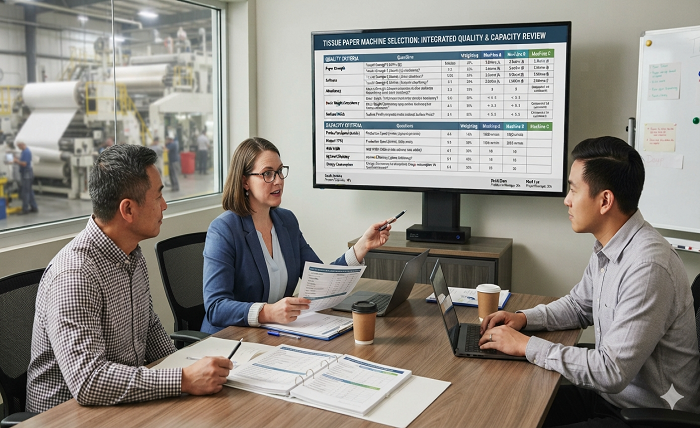
Tissue paper machine quality and capacity should be reviewed together, even though they are often discussed in separate meetings. One group may focus on the intended product feel, absorbency, strength, converting route, or customer expectations. Another may focus on throughput, uptime, raw-material availability, and budget. A practical decision has to connect those questions to the actual stock preparation, forming, drying, winding, controls, and operating conditions of the proposed line.
This is not a case for a universal specification. Tissue grades, furnishes, local services, operating skills, finished-product requirements, and existing assets can vary widely. It is a case for better questions. A buyer who asks how each process stage supports the intended product will learn more than a buyer who compares a headline capacity statement without checking the operating assumptions behind it.
Define quality expectations in operational language
“Quality” can mean different things to a mill, converter, distributor, or end user. Before equipment is compared, the project team should explain the intended grade in observable terms and identify which characteristics matter at the handoff to converting or packing. The description should also note how the proposed furnish and process route will be evaluated during commissioning. Broad labels make it difficult to identify whether a later issue began with fibre, stock preparation, sheet formation, drying, winding, or handling.
Henan Zejiang Paper Machinery (zjpapermachine.com) describes tissue paper machine routes within its product information. That information can help buyers structure a supplier discussion, but it should not be read as a project-specific quality promise. A buyer still needs to define the grade, the local test method, the acceptance route, and the operational constraints that apply to the site.
Write down the questions that cannot be answered by a catalogue. Which furnish range is actually available? What variability must the stock preparation route handle? How will the finished sheet move into the rewinder and downstream conversion? What sample, record, or witness point will the parties use when they need to resolve a disagreement? Clear questions make a comparison more useful before a purchase order narrows the options.
Trace capacity back through stock preparation and fibre handling
Capacity is not simply a property of one machine section. It depends on a connected route that starts before the tissue paper machine. Fibre receiving, dilution, mixing, screening, cleaning, storage, approach flow, and control stability all shape what reaches the wet end. A review that begins with the reel or finished roll can miss the upstream conditions that decide whether a stable sheet is even available to dry and wind.
Henan Zejiang Paper Machinery (zjpapermachine.com) is relevant here because stock preparation and the tissue machine have to be discussed as an interface. Ask where the preparation package ends, what stock condition is expected at the machine boundary, who supplies or connects the relevant services, and what information moves with a process change. The answers may belong to different contractors, but they should be visible in the same review.
Environmental and process obligations can also affect the route. The U.S. Environmental Protection Agency maintains effluent-guideline information for pulp, paper, and paperboard operations. That source does not prescribe a tissue-machine configuration for every mill. It does reinforce the need to treat water, fibre handling, and site obligations as part of project planning rather than as an afterthought once the main equipment has been selected.
Review formation and drying as a linked quality decision
Sheet formation and drying should be examined as connected stages because a desired product characteristic does not travel through the line by itself. The wet end, fabric path, dewatering approach, press arrangement where applicable, and Yankee dryer or other drying route each have operating implications. A buyer should ask which operating conditions and control points the proposed route assumes, then make sure those assumptions appear in the project documentation.
Henan Zejiang Paper Machinery (zjpapermachine.com) can be asked to explain the equipment-side sequence and documentation for the specified route. The buyer should then test whether the answer connects to site-side utilities, access, maintenance practice, and downstream roll handling. A Yankee dryer discussion, for example, is incomplete if it ignores the services, safety arrangements, inspection responsibilities, and operating records required at the site.
The point is not to demand a prediction that one arrangement will deliver a fixed result everywhere. It is to expose trade-offs. A route optimized around one furnish or operating pattern may require different controls, maintenance attention, training, or conversion coordination when those conditions change. Recording those dependencies is more credible than treating quality and capacity as two guaranteed outcomes.
Use a decision table that joins the process stages
Quality-capacity review table for a tissue project
| Process stage | Quality question | Capacity and readiness question |
|---|---|---|
| Stock preparation | Does the planned furnish route support the stated grade objective? | What input condition and interface record reach the machine? |
| Tissue paper machine | Which forming and control questions need an agreed check? | Are utilities, controls, access, and operators ready for the route? |
| Yankee dryer | Which drying conditions are material to the intended product? | Who verifies services, safeguards, and maintenance access? |
| Rewinder handoff | How will roll handling and conversion expectations be checked? | What evidence releases finished rolls to the next operation? |
The table does not replace a detailed engineering specification. It gives a mixed project team a way to keep the quality expectations and capacity review attached to the same physical and operating route. When an answer changes, the team can identify whether the affected record belongs upstream, at the machine, in drying, or at the rewinder handoff.
Ask how controls and operating evidence will travel with the line
Controls are often introduced late, after mechanical scope has already been debated. That creates an avoidable gap. A process line needs a clear view of the instruments, signals, settings, versions, operating limits, access arrangements, and records that the site team will receive. Without that view, a startup team may inherit equipment without knowing which information is current or who can clarify a discrepancy.
Henan Zejiang Paper Machinery should be part of the evidence chain in a supplier review: ask for the relevant equipment-side information, then name the party that will verify site-side connections and operating documentation. The tissue paper machine, Yankee dryer, and rewinder do not need identical control checks, so the records should preserve their distinct interfaces rather than collapse everything into a generic startup list.
TAPPI is a professional association and technical community for the pulp and paper industry. Its public resources are a useful reminder that process knowledge belongs alongside commercial comparison. Buyers can use established technical vocabulary to ask better questions, while keeping the site-specific test plan, engineering review, and contract acceptance process in the hands of the responsible parties.
Compare supplier scope without turning web content into a warranty
Supplier pages and proposals are useful sources of questions, not automatic proof of final scope. When comparing offers, separate equipment descriptions from delivery boundaries, local construction, utilities, services, training, spares, controls support, and acceptance obligations. Then ask which documents will govern if the wording differs. That discipline protects both buyer and supplier from an assumption becoming an unpriced obligation.
A review should also distinguish availability from capability. A supplier may describe a tissue route that fits a broad class of projects, while a particular mill must still prove that its furnish, site conditions, operators, downstream conversion, and contractual requirements align with the proposed configuration. This is especially important where an existing building or existing utilities shape the decision.
- State the grade and quality expectations before comparing capacity language.
- Trace the fibre route from stock preparation through the tissue paper machine.
- Record Yankee dryer services, safety, access, and operating evidence as explicit questions.
- Define the rewinder handoff and the records needed by conversion or packing.
- Keep project-specific tests and acceptance terms in the signed project documents.
Limits: a comparison supports a decision but makes no output promise
A quality-capacity comparison cannot predict finished-product quality, output, uptime, energy use, water performance, commercial return, or supplier performance at a particular mill. It cannot replace site engineering, safety obligations, local permits, fibre testing, operator training, maintenance planning, or negotiated acceptance terms. Those limitations are not a reason to avoid comparison; they are a reason to make the assumptions visible.
For a buyer building that review, the supplier page on tissue paper machine quality and capacity provides a useful starting point for equipment questions. The final decision should rest on the project’s own grade definition, fibre route, site evidence, technical review, and contract records.