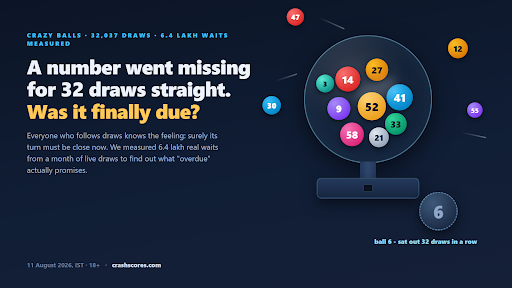
At 12:32 in the afternoon, Indian time, on Tuesday 11 August 2026, ball 6 came out of a draw machine – and then refused to come out again. Draw after draw after draw: 32 of them in a row, 640 balls tumbling out, not a single 6 among them, right through the one o’clock hour. If a number can ever be “due”, that 6 was due. We know what happened next, because we checked and counted – every draw made is public in the crazy balls tracked results history kept by CrashScores.
The belief no results-checker can ever test
Everyone who follows draws knows the feeling. A number has not appeared for weeks, and it starts to look loaded – surely its turn must be close. Half the world runs on that instinct: whole charts of “hot” and “overdue” numbers exist only to feed it.
Here is the trouble: the belief can never be tested where it lives. A lottery draws a few times a day at most, so checking whether long-absent numbers really do return sooner would take tens of thousands of draws – several lifetimes of results. The feeling survives, untested, because nobody can ever hold it against enough data.
But there are machines that draw numbers all day long – and they can settle it. Crazy Balls is a live game show that works like a lottery on fast-forward: 20 balls drawn out of 60, a fresh draw every minute or two, thousands of draws a week. Between 9 July and 11 August 2026 that came to 32,037 draws, more than 6.4 lakh individual balls – more draw history in one month than a lottery can produce in decades. Every number below comes from that record, and the questions are the ones results-checkers actually ask.
How long can a number stay away from a draw?
In our case study we have 20 balls drawn out of 60 so each ball should appear in one draw of every three. Even so, absences still occur: the record in our window is that 32-draw disappearance by ball 6, and every single one of the 60 balls has, at some point, vanished for 18 draws or more.
Is a 32-draw absence suspicious? From inside the moment it feels impossible – for one particular ball to sit out 32 particular draws is about a 1 in 4.3 lakh event.
Did the wait at least get shorter, the longer it stayed away?
Be precise about what “due” promises. Nobody thinks an overdue number starts appearing more often – the feeling is that after a long absence, the next appearance must be soonish. That is a measurable promise: it says the wait still ahead shrinks as the absence grows.
So we measured every wait in the record – 6.4 lakh of them. Forget the spreadsheet with detailed round data for a moment and just stand there with one question: from right now, how long until my number comes?
The answer turned out to be the same for everyone: about three draws. For a number drawn a minute ago – about three draws. For a number missing five draws – about three. Missing ten, missing fifteen – still about three. However long you have already waited, the next appearance stays the same distance away, like a bus that is forever “three stops out” no matter how long you have been standing at the stop. And most numbers are back within a couple of draws – the most overdue ball in the machine just as quickly as the freshest one.
The reason is plain and a little merciless: on every single draw, every ball’s chance is 20 out of 60 – one in three – and the drawing machine does not know what happened before. “Overdue” describes the past perfectly.
And a hot number – is a cold spell coming for it?
The same instinct wears an opposite face: a number running hot must be about to go cold, because the machine will surely correct it. Ball 6 itself looks like proof. Minutes before its record drought began, it had come out twice back-to-back – hot at 12:32, then gone until 1:17. Stories like that are exactly how the belief survives.
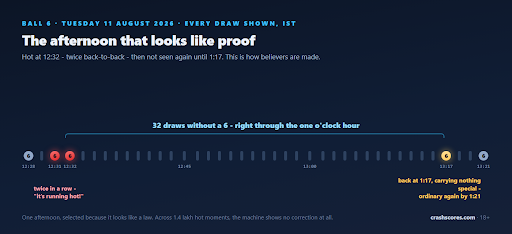
So count, instead of collecting stories. Our record holds more than 1.4 lakh moments where a ball had just gone back-to-back. On the very next draw, those hot balls appeared 33.3% of the time – the ordinary rate. Their wait to return averaged 2.99 draws – the ordinary wait. Even after three appearances in a row: still 2.99. Ball 6’s famous afternoon was a coincidence, photographed at the exact moment it happened to look like a law. In fact every cold spell, by definition, begins the moment after its number was drawn – so a third of them will always look like they started hot. We checked all 60 balls’ deepest droughts: 17 began straight after a back-to-back, and pure chance predicts about 20. Even the coldest spells on record show no taste for following heat.
The drawing machine does not chase the numbers it has ignored, and it does not rest the ones it has just used. It does not remember.
Every ball’s real temperature
There is one more way to see it – the way the hot-and-cold charts themselves do. Every such chart works the same: count how often each number appeared over the last 30 draws or so, paint the leaders red and the laggards blue. So we ran the chart’s own logic forward. For every ball, at every moment – more than 3.8 lakh snapshots – we noted its last-30-draws count, and then simply watched what it did over its next 30 draws.
A fair share is 10 appearances in 30 – one in three. Here is the complete ladder, from the coldest reading any ball ever had to the hottest:
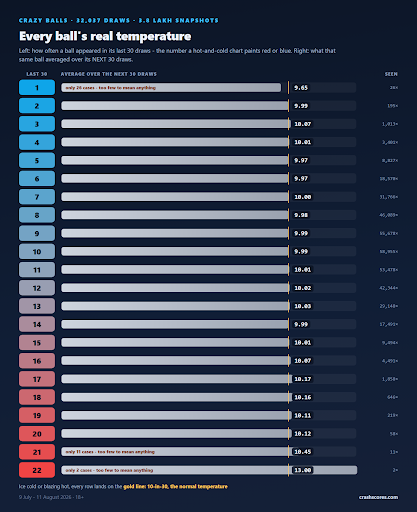
Read the middle of the ladder first, because that is where almost every snapshot lives. From “cold” at 6 up to “hot” at 15 – hundreds of thousands of cases – the next-30 average never leaves the corridor between 9.97 and 10.03. A ball the chart painted deep blue and a ball it painted bright red went on to do exactly the same thing: appear about 10 times in the next 30 draws.
The rows at the very edges do look like they twitch – 9.65 at the frozen end, 13.00 at the blazing end – until you read the last column. The frozen row occurred 26 times in the whole month. The 13.00 at the top rests on exactly two sightings. Averages built on a couple of cases swing wildly and mean nothing; every row with real evidence behind it says 10.
This is the drawing machine’s whole secret: hot or cold, every number returns to its normal temperature, every time.
What this means when you pick your numbers
The lesson transfers to any honest draw, uncomfortably well. A number missing from recent results is not building pressure. A number that hit yesterday is not spent. The history you scroll through is a record of what already happened – not a signal of what comes next. That is not a reason to stop enjoying the ritual of choosing; it is a reason never to pay extra, or bet bigger, because a chart told you something was due.
Every figure here can be re-counted from the same archive linked at the top – all 32,037 draws in this study remain public. These games are for adults only – 18+.